

Electricity from the Heart of the Sea; Are Iran's Coasts Ready for the Development of Offshore Wind Farms?
The development of offshore wind farms has become one of the pathways to diversify electricity generation sources worldwide. However, having long coastlines alone is not sufficient to enter this industry. Wind speed, water depth, investment costs, port infrastructure, and the ability to connect to the power grid are determining factors in assessing Iran's capacity.
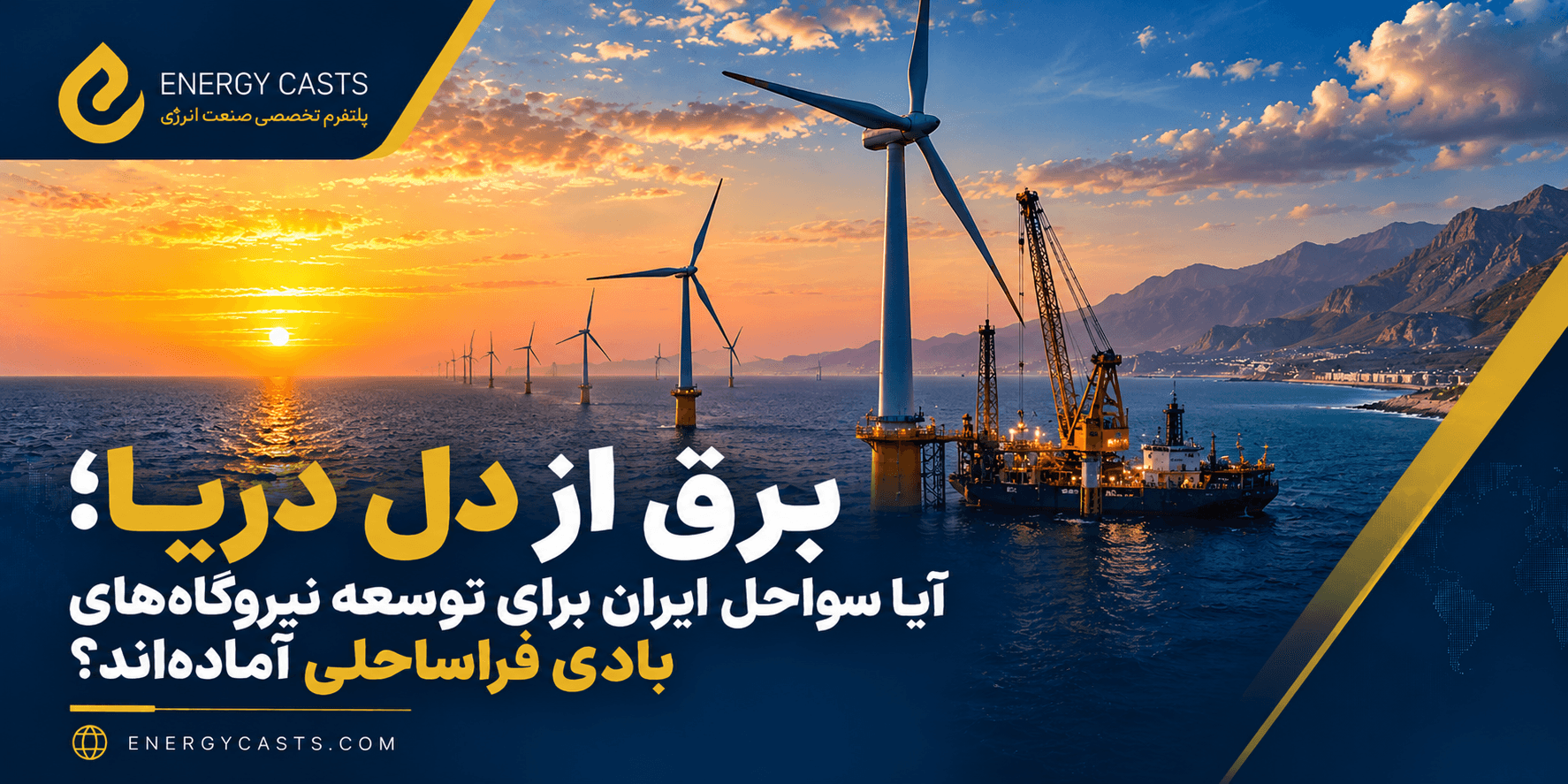
Iran has potential for exploring the development of offshore wind farms due to its access to the Persian Gulf, Oman Sea, and Caspian Sea. However, the economic viability of this technology depends on wind speed, water depth, investment costs, port infrastructure, and the ability to connect to the power grid. Determining the exploitable capacity of the country requires specialized studies and independent feasibility assessments.
Offshore wind energy; an opportunity beyond electricity generation
The development of renewable energy in the world has gradually expanded from land to sea. Offshore wind farms, built in coastal waters and away from land, enable the utilization of wind resources in areas that may be suitable for electricity generation in terms of wind speed and stability.
According to EnergyCast, the development of this technology is not limited to increasing electricity generation capacity. The construction and operation of offshore power plants can create new demand for port services, steel industries, submarine cables, specialized vessels, and engineering services.
Tasnim News reported in an article titled 'Blue Economy; the necessity of entering offshore wind energy' published on October 17, 2026, that this industry is one of the important sectors of the ocean-oriented economy and discussed its connection to energy security and the development of industrial infrastructure.Tasnim News
However, the main question for Iran is whether the technical and economic conditions of the country's coasts justify investment in this technology?
Global capacity; an emerging industry with serious challenges
According to statistics cited in the Tasnim report, the installed capacity of offshore wind farms worldwide is expected to reach about 92.5 gigawatts by the end of 2025.
Additionally, around 9.3 gigawatts of new capacity will be connected to the global electricity grid in 2025, with China accounting for a significant share of the development of this industry.
These figures indicate the expansion of the offshore wind industry, but the growth of installed capacity does not mean that economic barriers have been overcome.
Increasing financing costs, supply chain limitations, delays in permitting, and difficulties in connecting power plants to the electricity grid are challenges that have slowed the development of this industry in some markets.Tasnim News
Therefore, assessing Iran's opportunities must consider not only the natural wind capacity but also the economic and infrastructural conditions.
Persian Gulf and Oman Sea; potential capacity or economic opportunity?
Iran has access to vast water bodies in the north and south of the country. However, the length of the coasts is not a suitable criterion for estimating the capacity for offshore wind electricity generation.
To determine suitable areas, a set of specialized data is required, including wind speed and direction at turbine height, water depth, seabed characteristics, distance from the shore, and environmental conditions.
In the Persian Gulf, the relatively shallow water depth in many areas can provide a technical advantage for certain types of fixed structures. However, wind conditions, vessel traffic, oil and gas facilities, and environmental restrictions must be examined independently.
In the Oman Sea, the conditions of water depth and distance from the shore can also affect the choice of technology and project implementation costs.
Therefore, without wind measurement studies and feasibility assessments, it is not possible to conclude about the economic viability of constructing offshore power plants in these areas.
Experience in the oil and gas industry; an industrial advantage for Iran
One notable feature of Iran is its decades-long experience in developing offshore oil and gas infrastructure.
The design and construction of marine structures, installation operations of offshore equipment, buoyancy services, and maintenance activities are among the capabilities that can also be applied in the development of the offshore wind industry.
However, transferring these capabilities to the wind power industry requires the adaptation of technology and engineering standards.
For example, the equipment for installing large wind turbines, submarine power transmission cables, and power plant control systems differ from many conventional oil industry equipment.
Therefore, the experience of the oil and gas industry can be a suitable starting point, but it will not replace the development of a specialized offshore wind supply chain.
Economic challenge; is offshore electricity competitive?
Offshore wind farms generally require more initial investment compared to many onshore wind projects.
The costs of constructing foundations, transporting equipment, installing turbines at sea, building offshore substations, and submarine cabling are factors that increase costs.
Additionally, maintaining equipment in a marine environment requires specialized vessels and more complex operational planning.
In contrast, the possibility of using large turbines and harnessing suitable winds can help increase annual electricity production.
For the economic comparison of projects, the levelized cost of electricity or LCOE is important; however, this metric alone is not sufficient.
The time value of produced electricity, connection costs to the grid, transmission limitations, and financing costs must be considered in the final assessment.
What impact does offshore wind development have on Iran's electricity imbalance?
One of the important questions about the development of offshore wind energy is its potential role in reducing the electricity imbalance in the country.
From a technical perspective, the addition of new production capacity can help diversify electricity sources. However, the actual contribution of wind power plants to meeting demand depends on their production timing pattern.
For example, if wind power generation decreases during peak consumption hours, the nominal capacity of the plant alone will not indicate its contribution to managing peak load.
On the other hand, the development of offshore power plants is usually considered a medium- to long-term project due to the complexity of construction and connection to the grid.
Therefore, this technology should not be introduced as an immediate solution to electricity shortages without thorough examination.
The necessity of developing a national roadmap
Iran's entry into the offshore wind industry primarily requires the establishment of a reliable database regarding wind resources and the technical conditions of coastal areas.
After identifying suitable areas, the possibility of implementing small-scale pilot projects will be assessable.
Such projects can provide practical information about turbine performance, maintenance costs, marine limitations, and grid connection conditions.
Additionally, developing a legal framework for the exploitation of marine areas, determining the responsibilities of relevant institutions, and designing financing mechanisms are prerequisites for the development of this industry.
Energy summary
Offshore wind can be one of the options for diversifying Iran's electricity production portfolio in the long term, but its success depends on having economically viable wind resources, suitable infrastructure, and accessible investment.
Iran's experience in the offshore oil and gas industry provides significant industrial capacity for entering this field; however, decisions regarding the construction of offshore power plants should be based on independent studies and economic comparisons with other electricity production options.
The main question is not merely whether Iran can generate electricity at sea; rather, it is which areas, with what technology, and at what cost will offshore electricity generation be economically justified.
- #نفت
- #پتروشیمی